
Books ›
14th century · Mount Liang
Water Margin
How 108 wronged people became the most feared band in Song dynasty China
How this book came to be
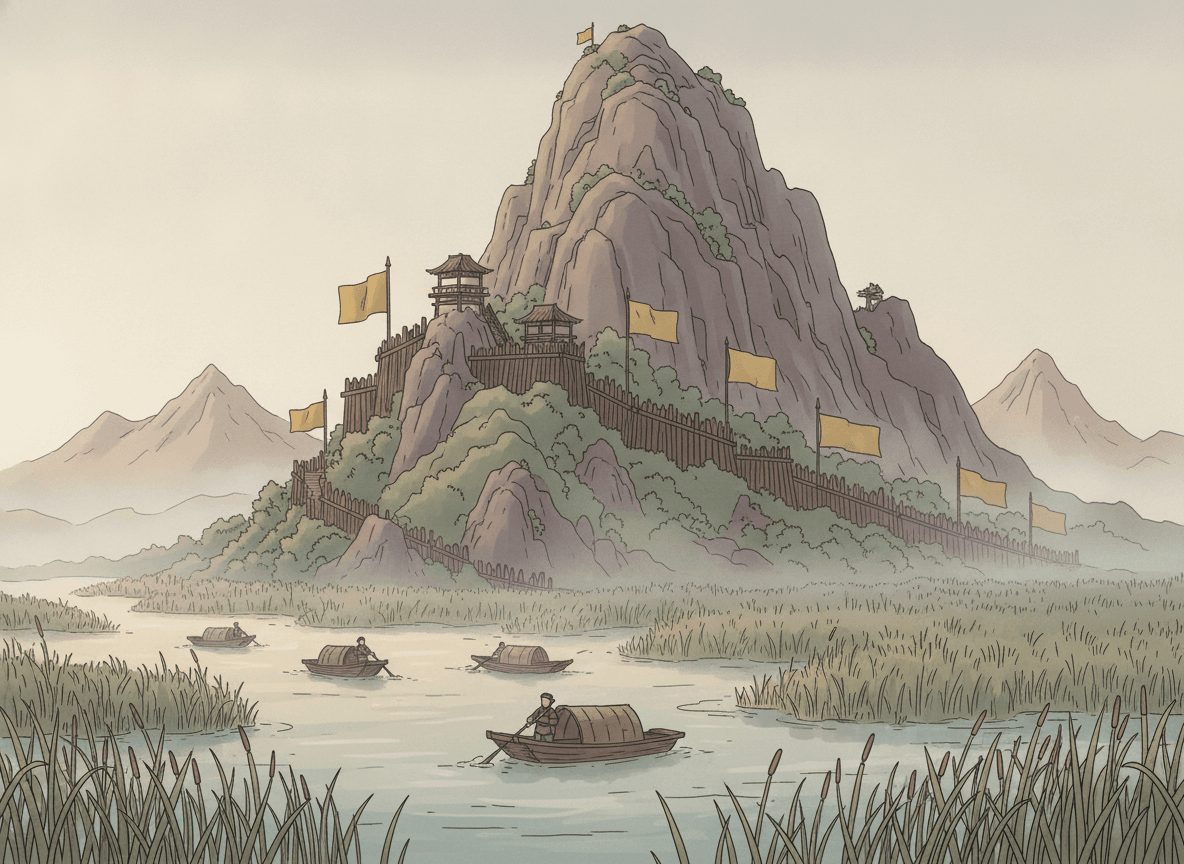
Water Margin is a vast adventure novel about 108 outlaws who gather in a marsh fortress at Mount Liang, in eastern China, and defy corrupt officials. It is counted among the four great classic novels of Chinese literature.
Its roots are real. In the early 1120s, a bandit leader named Song Jiang troubled the Song dynasty government, and official histories record his surrender. His story did not end there, because professional storytellers took hold of it. Over the next two centuries they added new heroes and new feats. Playwrights under the Mongol Yuan dynasty put the outlaws on stage. By the time anyone shaped the material into a novel, audiences already knew the cast.
Who shaped it is uncertain. Tradition names Shi Nai'an, a scholar linked to Xinghua in Jiangsu province, and dates the book to around 1370. That would place him in the turmoil that ended Mongol rule and brought the Ming dynasty to power in 1368. Later accounts say he gave up a minor government post to write. Almost nothing about his life can be verified, though, and some scholars doubt he existed at all. Some early editions also name Luo Guanzhong, best known for Romance of the Three Kingdoms, as author or co-author. The oldest printed copies that survive date only from the 1500s.
The choice of language is not in doubt. The book uses the everyday spoken Chinese of its time instead of the classical style that scholars wrote in. As a result, it could be read aloud and enjoyed far beyond the educated elite.
Rulers saw a danger in it, because the book makes rebels admirable. In 1642, with real uprisings spreading, the Ming court ordered it banned and its printing blocks destroyed. The Qing dynasty that followed banned it again. The novel survived anyway, partly thanks to Jin Shengtan, a literary critic. In the 1640s he cut the text to seventy chapters, which removed the later part where the outlaws accept a pardon and fight for the emperor. His shorter version was the one most Chinese readers knew for nearly three hundred years.
The story also traveled. Japan adopted it as Suikoden, and it inspired Japanese novels and woodblock prints. Pearl S. Buck, an American novelist raised in China, translated it into English in 1933 as All Men Are Brothers. Television series and video games have since retold it. Mao Zedong, the leader of Communist China, read it eagerly as a schoolboy. In 1975 he launched a political campaign against the book, attacking Song Jiang for surrendering. Eight centuries after the real bandit laid down his arms, his choice was still a matter of national politics.
Continue in the app
Open the app for the illustrated story of this book and the world it was written in. The book itself is not included: it is still in copyright, so read it on Kindle or import your own EPUB into the app's library.
- ✓ The illustrated story of the book
- ✓ The world it was written in, on the map and timeline
- ✕ The full text is not included (in copyright)
Illustrations are created with AI assistance. Summaries are written with AI and reviewed by the editor. Book metadata comes from Wikidata and Open Library.