
Books ›
1913 to 1927 · Illiers-Combray
In Search of Lost Time
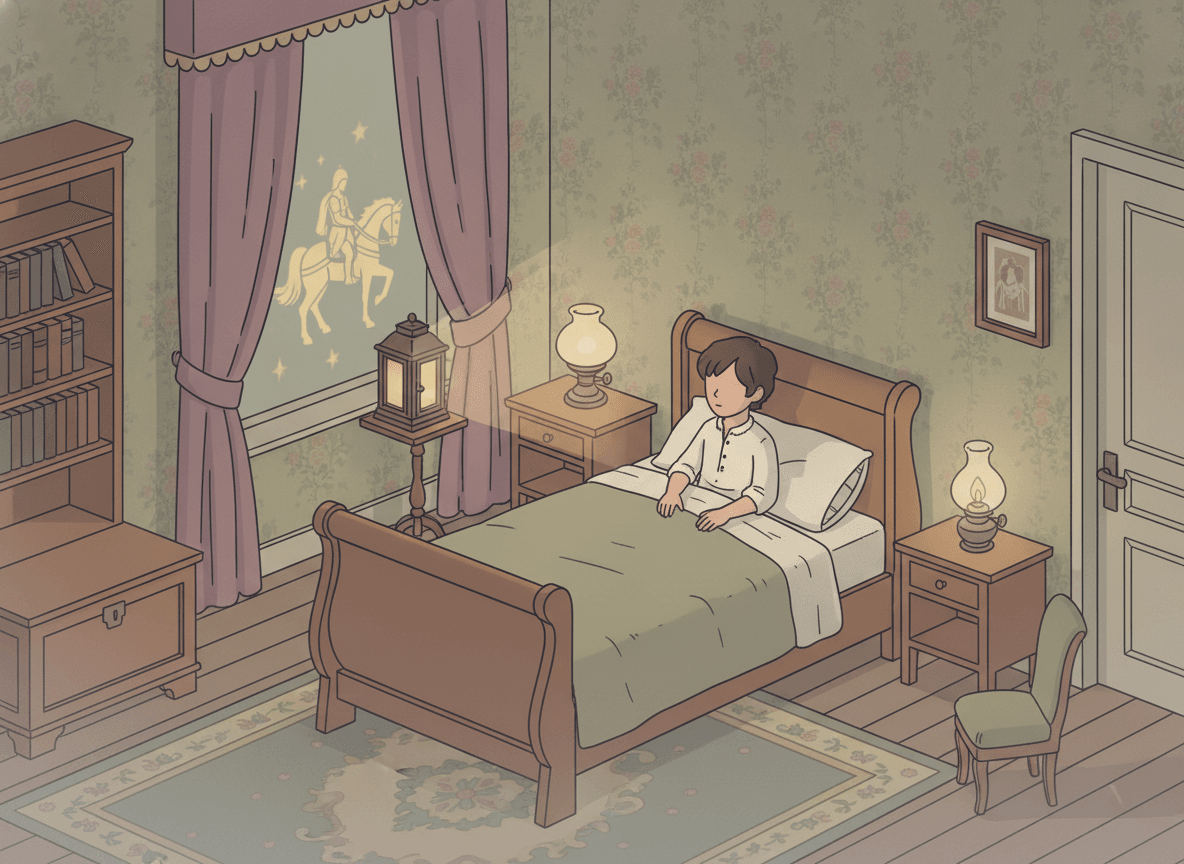
A sickly boy waits for a kiss, a man waits for his calling, and a whole life hides inside a cup of tea.
How this book came to be
In 1909, Marcel Proust was in his late thirties. He had published little, and Paris knew him mainly as a guest in fashionable drawing rooms. His mother had died in 1905, and the loss left him grieving and adrift. Severe asthma kept him indoors, so he slept by day and wrote in bed at night.
The book began as something else. Proust planned an essay against Sainte-Beuve, a famous critic who judged books by the lives of their authors. Proust believed the self that writes lies deeper than the one seen at dinner parties. As he worked, memories and invented scenes crowded into the essay until it turned into a novel. In it, a narrator looks back on his childhood and his years in French high society, and slowly discovers how to become a writer.
In 1910 he had his bedroom at 102 boulevard Haussmann lined with cork, because noise made work impossible. He revised without end. When the margins filled up, he wrote on strips of paper, and his housekeeper, Céleste Albaret, glued them to the pages in long folding chains.
Publishers did not want it. Several refused the first volume, Swann's Way, including the Nouvelle Revue Française, a young literary house where the writer André Gide helped choose manuscripts. Proust finally paid the publisher Bernard Grasset to print it in November 1913. Gide soon wrote to apologise for the mistake.
Then the First World War halted publication. The delay gave Proust years to enlarge his plan, so a novel designed in three volumes grew to seven. In 1919 the second volume won the Prix Goncourt, France's leading literary prize. The choice caused an uproar, because many people felt the award belonged to a war novel by Roland Dorgelès, a veteran of the trenches.
Proust died of pneumonia in November 1922, still revising. The last three volumes appeared after his death, the final one in 1927. His brother Robert, a doctor, helped prepare them for print. Because Proust never finished correcting them, editors still argue over parts of the text.
English readers met the book through C. K. Scott Moncrieff, a Scottish translator. He took his title, Remembrance of Things Past, from a Shakespeare sonnet. Proust complained that it lost his meaning, and later editions returned to the literal title.
The novel runs to more than a million words, and it changed what fiction could do with memory and inner life. Virginia Woolf, the English novelist, read it with awe. Today we call a taste or smell that suddenly brings back the past "Proustian".
Continue in the app
Open the app for the illustrated story of this book and the world it was written in. The book itself is not included: it is still in copyright, so read it on Kindle or import your own EPUB into the app's library.
- ✓ The illustrated story of the book
- ✓ The world it was written in, on the map and timeline
- ✕ The full text is not included (in copyright)
Illustrations are created with AI assistance. Summaries are written with AI and reviewed by the editor. Book metadata comes from Wikidata and Open Library.