
Books ›
c. 1599 to 1601 · Elsinore
Hamlet
A ghost, a poisoned crown, and a prince who has to be sure before he strikes.
How this book came to be
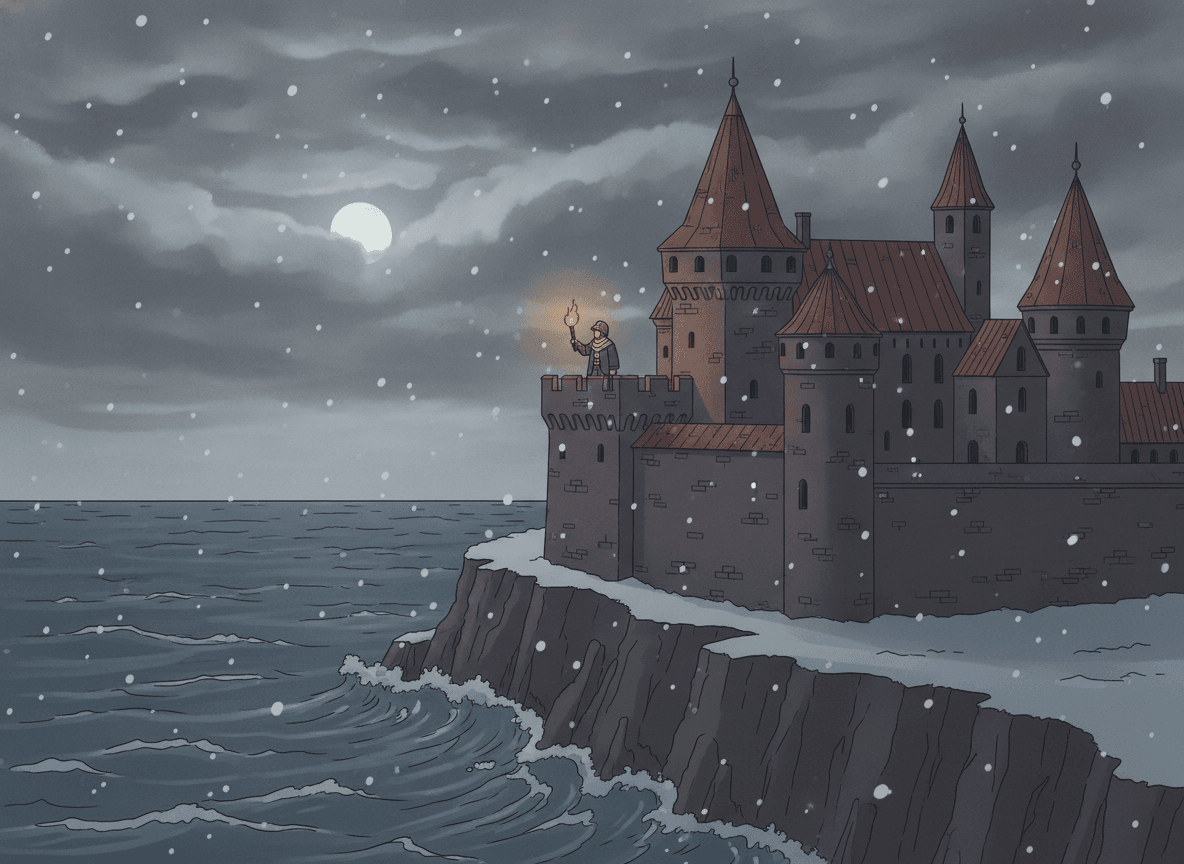
Hamlet is a tragedy about a prince of Denmark. His father's ghost tells him that the new king, the prince's own uncle, murdered him. The ghost asks for revenge.
William Shakespeare wrote it in London around 1600. He was in his mid-thirties and already a successful playwright. He was also a part-owner of his acting company, the Lord Chamberlain's Men, so a hit play earned him money directly. In 1599 the company had opened the Globe, a new playhouse on the south bank of the Thames, and it needed strong plays to fill it.
The story was old. Saxo Grammaticus, a Danish historian, had written down the legend of a prince called Amleth around 1200. François de Belleforest, a French writer, retold it in 1570. A Hamlet play was on the London stage by 1589, but it is lost. Its author is unknown, though some scholars suggest Thomas Kyd, a playwright known for revenge drama. Shakespeare kept the revenge plot and changed its heart, because his avenger hesitates and thinks aloud.
The mood of the time suited the play. Queen Elizabeth I was old and childless, so nobody knew who would rule next, and a story about a troubled succession touched a real fear. Shakespeare had private griefs too. His only son, Hamnet, had died in 1596 at the age of eleven, and his father died in 1601. Many readers sense those losses in the play. That link is a guess, because no document confirms it.
Richard Burbage, the company's leading actor, was the first Hamlet. The play caught on quickly, which is why printers hurried to sell it. A short, garbled version came out in 1603 as a quarto, a small and cheap book. A much longer text followed about a year later. A third appeared in the First Folio of 1623, the collected plays that fellow actors published after Shakespeare's death. The three texts differ, so editors still have to choose what to print.
It is Shakespeare's longest play. A full performance runs about four hours, so most productions cut it, and every cut makes a slightly different Hamlet. That is one reason actors keep returning to the part. Writers return to it as well. Sigmund Freud, the founder of psychoanalysis, studied the prince in his book on dreams in 1899. In 1966 the playwright Tom Stoppard retold the story through two minor courtiers in Rosencrantz and Guildenstern Are Dead. People who have never seen the play quote it anyway, each time they say that brevity is the soul of wit.
Continue in the app
Open the app for the illustrated story of this book and the world it was written in. The book itself is not included: it is still in copyright, so read it on Kindle or import your own EPUB into the app's library.
- ✓ The illustrated story of the book
- ✓ The world it was written in, on the map and timeline
- ✕ The full text is not included (in copyright)
Illustrations are created with AI assistance. Summaries are written with AI and reviewed by the editor. Book metadata comes from Wikidata and Open Library.