
Books ›
1944 · Buenos Aires
Ficciones
A missing country, an endless library, a spy with one bullet, and a man on a train heading south.
How this book came to be
Ficciones is a slim book of seventeen short stories. Many pose as book reviews or detective tales, and they turn on endless libraries and invented worlds.
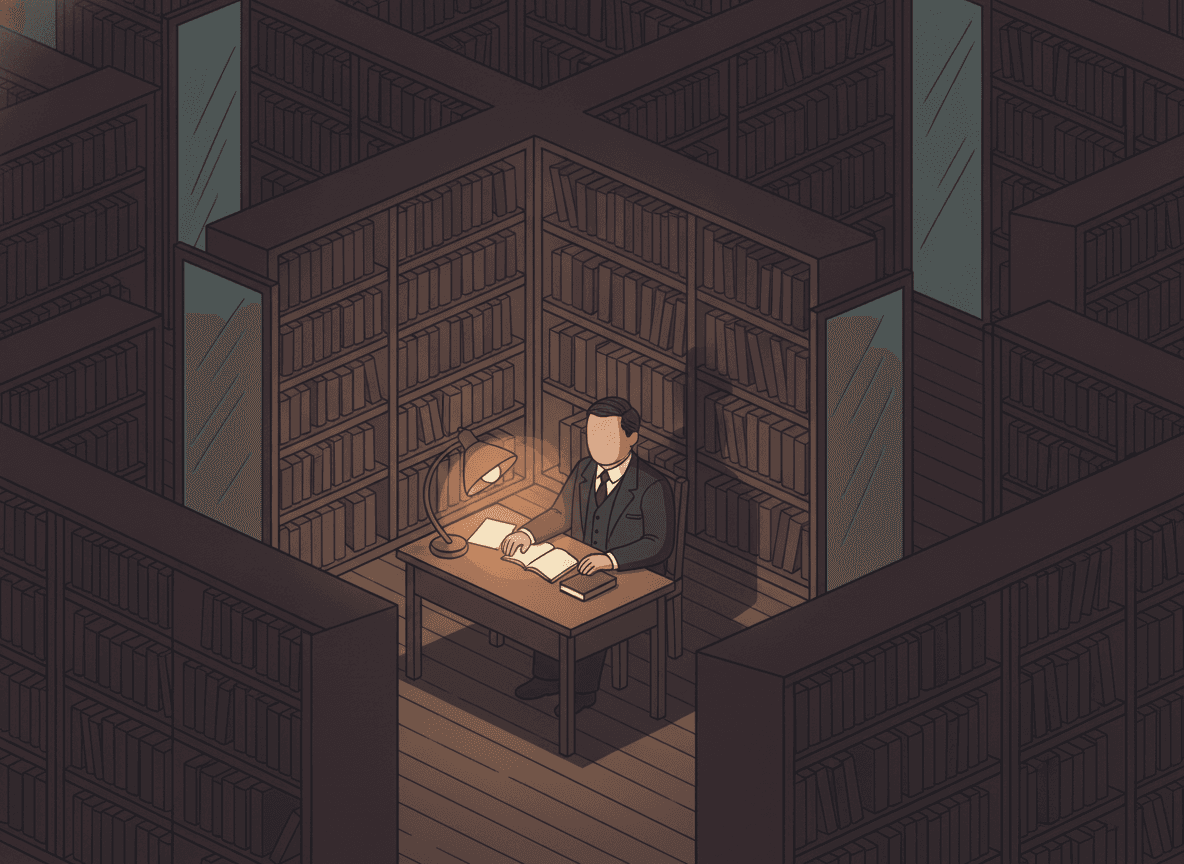
In the late 1930s, Jorge Luis Borges was close to forty and known in Buenos Aires as a poet and essayist. He needed a salary, so he took a modest job cataloguing books at the Miguel Cané municipal library. He later said the day's work took him about an hour. He spent the rest reading and writing, out of sight in the basement or on the roof. That job fed "The Library of Babel", his story of a library with no end.
On Christmas Eve 1938, a few months after his father's death, he hurried up a staircase and struck his head on an open window. The wound became infected and turned into blood poisoning. He lay for weeks in fever and nearly died. By his own account, he recovered with one fear: that his mind was damaged. A failed poem or essay would have confirmed it, so he tried a form he felt less tied to, the short story. The result was "Pierre Menard, Author of the Quixote". He had published a little fiction before, but this was the turn.
The stories first appeared in Sur, the literary magazine founded by Victoria Ocampo, an Argentine writer and publisher. Eight were collected in 1941 as The Garden of Forking Paths. The book was passed over for the National Prize for Literature, and Sur answered with a whole issue in which fellow writers defended him. In 1944 Borges added six stories under the heading Artifices and published the two parts together as Ficciones. Three more stories joined in 1956.
Recognition at home stayed fragile. In 1946 the government of Juan Perón, the new president whom Borges had openly opposed, removed him from the library by "promoting" him to inspector of poultry and rabbits at the public markets. He resigned.
Fame came from abroad. Roger Caillois, a French writer who had spent the war years in Argentina, had the book published in French in 1951. In 1961 Borges shared the international Formentor Prize with Samuel Beckett, the Irish writer, and English editions followed in 1962. By then hereditary blindness had taken his sight, so he could not read the books that carried his name around the world.
Gabriel García Márquez, the Colombian novelist, and a generation of Latin American writers learned from him. Umberto Eco, the Italian novelist, put a blind librarian named Jorge of Burgos in The Name of the Rose as a nod to him. Many readers now see in his endless library an early picture of the internet, imagined decades before it existed.
Continue in the app
Open the app for the illustrated story of this book and the world it was written in. The book itself is not included: it is still in copyright, so read it on Kindle or import your own EPUB into the app's library.
- ✓ The illustrated story of the book
- ✓ The world it was written in, on the map and timeline
- ✕ The full text is not included (in copyright)
Illustrations are created with AI assistance. Summaries are written with AI and reviewed by the editor. Book metadata comes from Wikidata and Open Library.