
Books ›
1605 to 1615 · La Mancha
Don Quixote
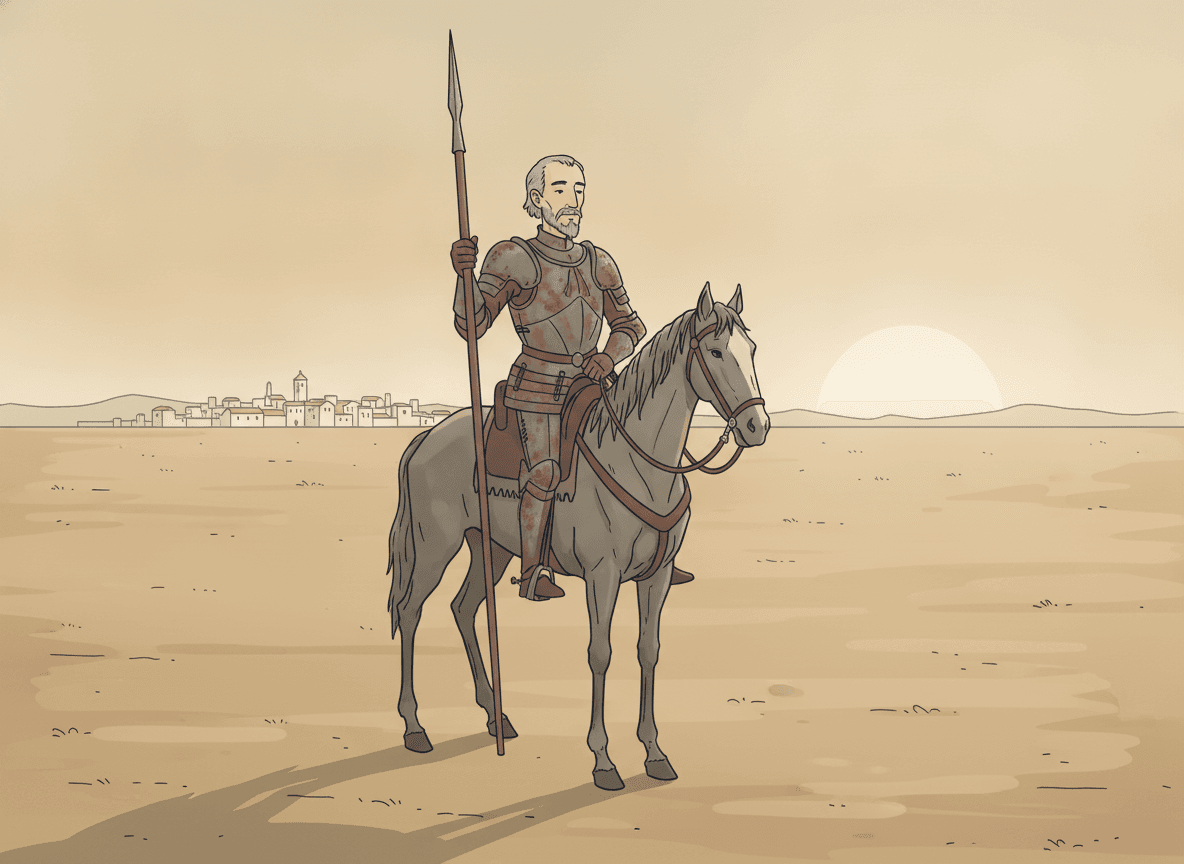
A bony horse, a barber's basin, and a man who decided the world should match his books.
How this book came to be
Miguel de Cervantes was 57 and close to broke when Don Quixote appeared. Life had been rough on him. As a young soldier he fought the Ottoman fleet at the battle of Lepanto in 1571, where a gunshot wound cost him the use of his left hand. Four years later, corsairs seized his ship and he spent five years as a captive in Algiers, until a ransom bought his freedom. Back in Spain, his plays and his first novel earned little, so he took work as a supply agent and tax collector for the crown. His accounts came up short, and in 1597 he was jailed in Seville.
In his prologue, Cervantes hints that the book was conceived in a prison. Many readers link this to the Seville jail, but nobody knows for certain.
The novel follows a country gentleman from La Mancha who reads too many romances of chivalry, the bestselling adventure tales about wandering knights. He decides to become a knight himself and rides out with Sancho Panza, a farmer he takes on as his squire, or knight's attendant.
Part One was printed in Madrid for Francisco de Robles, a bookseller, and went on sale in early 1605. Cervantes was then living in Valladolid, where the royal court had moved. Success came fast. Within months, unauthorized editions appeared in Lisbon, and crates of copies sailed to Spain's American colonies. Cervantes had sold his rights to Robles, so fame arrived without fortune.
Then came a theft. In 1614, a sequel was published under the name Alonso Fernández de Avellaneda, a pseudonym whose owner has never been identified. Cervantes was already writing his own Part Two, and he answered inside the story. His characters hear about the fake book and mock it. Don Quixote even changes his route, heading to Barcelona because the false version had sent him to Zaragoza. The real Part Two came out in 1615. Cervantes died in Madrid the following April.
By then the book had crossed borders. Thomas Shelton, its first translator, published an English version in 1612, and a French one followed in 1614. Later writers such as Henry Fielding, Gustave Flaubert and Fyodor Dostoevsky learned from it. It is often called the first modern novel because its characters doubt, argue and change. In Part Two, they even meet people who have read Part One.
In 2002, the Norwegian Book Clubs asked a hundred writers from 54 countries to name the best work of fiction ever written. The old soldier's book got the most votes.
Continue in the app
Open the app for the illustrated story of this book and the world it was written in. The book itself is not included: it is still in copyright, so read it on Kindle or import your own EPUB into the app's library.
- ✓ The illustrated story of the book
- ✓ The world it was written in, on the map and timeline
- ✕ The full text is not included (in copyright)
Illustrations are created with AI assistance. Summaries are written with AI and reviewed by the editor. Book metadata comes from Wikidata and Open Library.