
Books ›
1835–1872 · Copenhagen
Andersen's Fairy Tales
A soldier, a pea, a mermaid, a naked emperor and one very large grey egg: Andersen's tales, told again.
- Author
- Hans Christian Andersen
- Written
- 1835–1872
- Original title
- Eventyr, fortalte for Børn
- Original language
- Danish
- Form
- Short story
- Set in
- Copenhagen, Denmark
How this book came to be
In the spring of 1835, Hans Christian Andersen was thirty and, after years of scraping by, finally a name in Copenhagen. He had been born in Odense, the son of a poor shoemaker and a washerwoman. At fourteen he left for the capital with a few coins and a dream of the stage. He failed at acting, singing and dancing in turn. Then a patron, Jonas Collin, a senior official who ran the Royal Theatre, arranged for the state to pay for his schooling. Those school years were a misery under a bullying headmaster, but they made him a writer. In April 1835 his novel The Improvisatore, drawn from a trip to Italy, came out and earned him his first real praise.
A month later he published something far smaller. It was a cheap booklet of sixty-one pages called Eventyr, fortalte for Børn (Fairy Tales, Told for Children). It held four stories: "The Tinderbox", "Little Claus and Big Claus", "The Princess and the Pea" and "Little Ida's Flowers". Three reworked folk tales he had heard as a boy from old women in Odense, including those in the poorhouse where his grandmother worked. The fourth he made up himself. A second booklet followed in December with "Thumbelina", and a third in 1837 with "The Little Mermaid" and "The Emperor's New Clothes".
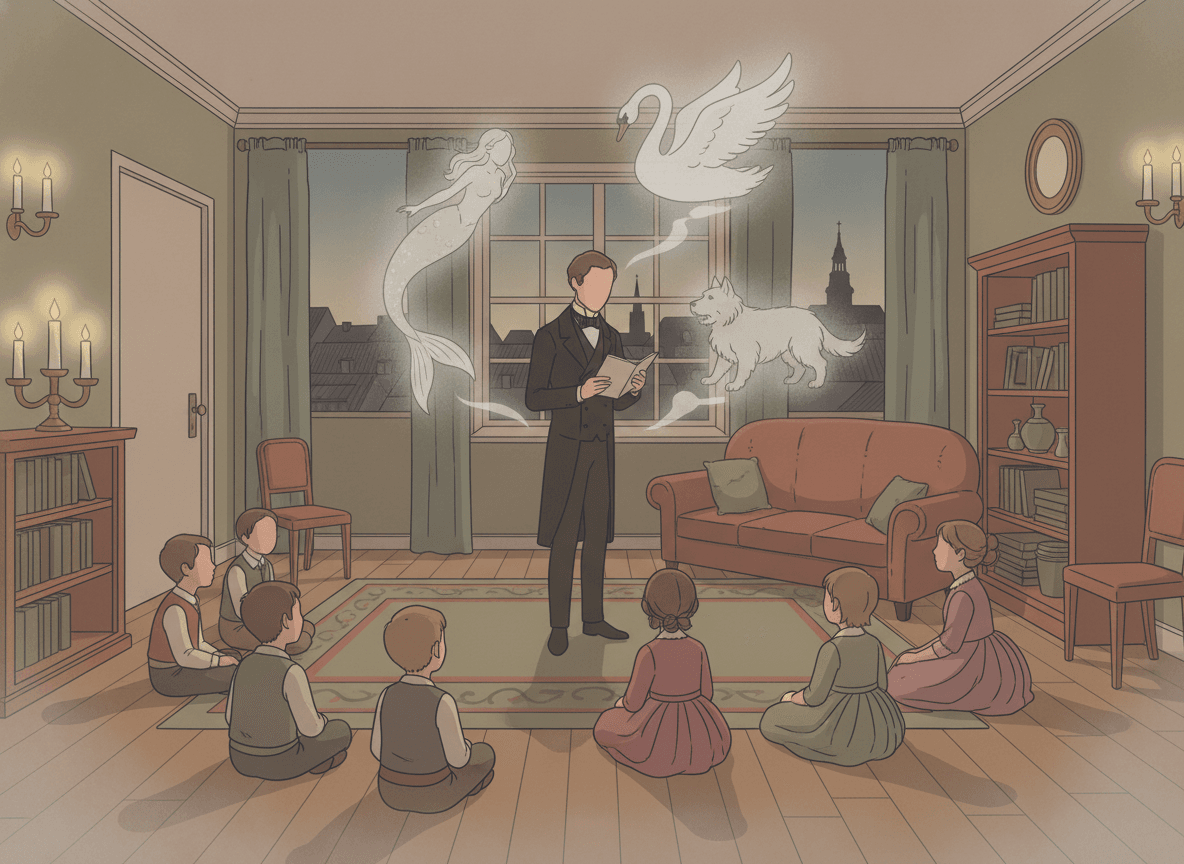
What was new was not the plots but the voice. Andersen wrote the way he talked, in plain spoken Danish, with jokes, asides and sentences starting with "and". He liked to read the stories aloud in friends' drawing rooms, and he wanted the page to keep that living sound. Copenhagen's critics disliked it. They found the style careless and the stories short on moral lessons, which was what children's books were supposed to supply. Andersen himself called the tales trifles and expected his novels to carry his reputation.
They did not. The tales sold steadily, so new ones kept coming. In 1843 he dropped "told for children" from the title, because he had come to see that adults were reading them too, and that the best tales, such as "The Ugly Duckling" from that same year, were really about his own life. German translations appeared in 1839 and English ones in 1846. By the late 1840s he was a European celebrity, received by kings and hosted by Charles Dickens, whose family grew weary of him during a five-week stay. By his death in 1875 he had written 156 tales.
Their afterlife is everywhere. They are among the most translated books in the world. "The emperor's new clothes" and "ugly duckling" are everyday phrases in many languages. The bronze Little Mermaid in Copenhagen harbour is the city's emblem, and International Children's Book Day falls on his birthday, 2 April. The washerwoman's son had turned the old folk tale into something new: a story that could carry one author's private hurt and hope, and still sound like it was being told across a kitchen table.
Continue in the app
Open the app for the illustrated story of this book and the world it was written in. The book itself is in the public domain: the app opens the free text in its reader, on screen or read aloud with Premium.
- ✓ The illustrated story of the book
- ✓ The world it was written in, on the map and timeline
- ✓ The free public-domain text, opened in the app's reader
Illustrations are created with AI assistance. Summaries are written with AI and reviewed by the editor. Book metadata comes from Wikidata and Open Library.