
Books ›
1865 · Oxford
Alice's Adventures in Wonderland
One dull afternoon, one White Rabbit, and a world where nothing keeps its size for long.
How this book came to be
On 4 July 1862, a rowing boat set off up the Thames from Oxford. At the oars was Charles Dodgson, a shy thirty-year-old who taught mathematics at Christ Church, one of the university's colleges. With him were Robinson Duckworth, a young clergyman friend, and the three daughters of Henry Liddell, the dean who ran the college. The girls asked for a story, so Dodgson made one up as he rowed. He named its heroine after the middle sister, ten-year-old Alice Liddell.
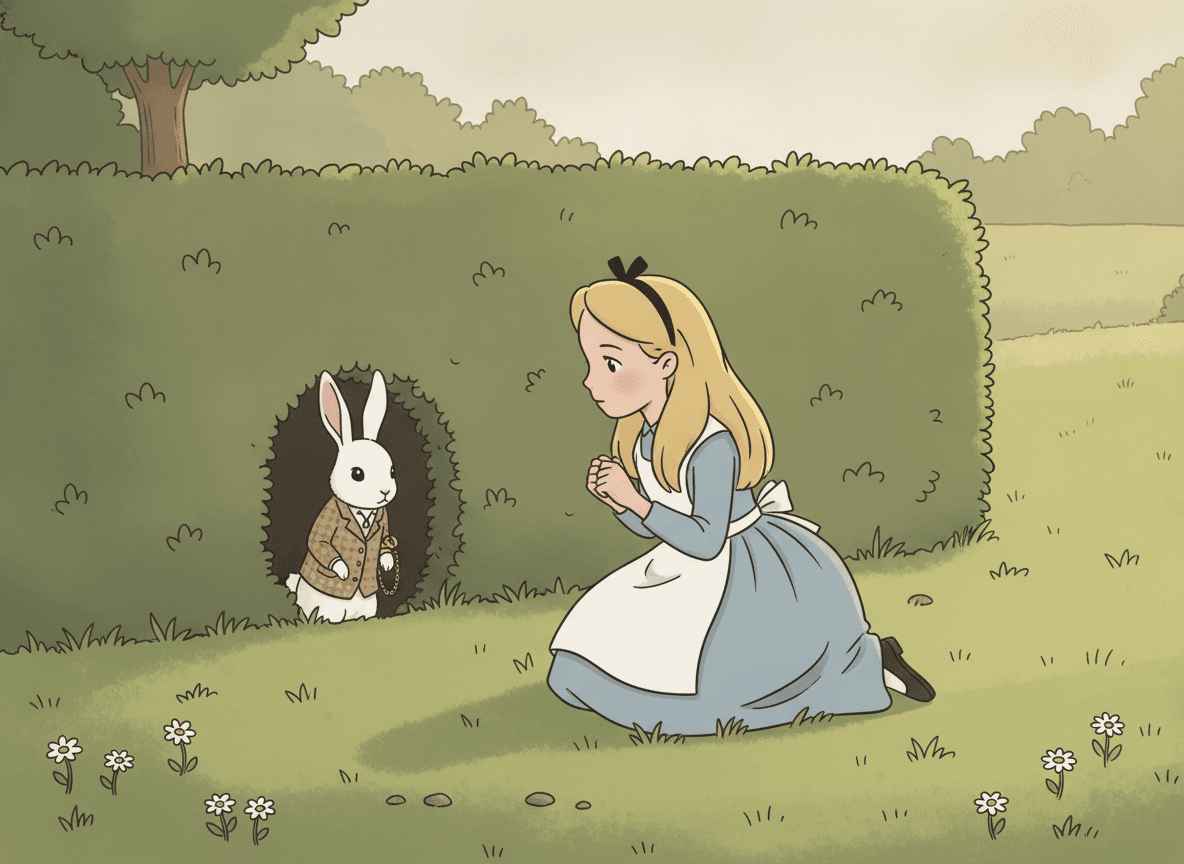
The tale follows a girl who falls down a rabbit hole into a world where rules and logic are turned upside down. Alice liked it so much that she begged him to write it down. It took him more than two years. In November 1864 he gave her a handwritten book with his own drawings, titled Alice's Adventures Under Ground.
It might have stayed a private gift. But Dodgson showed it to George MacDonald, a novelist friend, whose children loved it, and that convinced him to publish. He nearly doubled the text, adding the Cheshire Cat and the Mad Tea-Party. He paid for the production himself and hired John Tenniel, the leading cartoonist of the satirical magazine Punch, to draw the pictures. He signed the book Lewis Carroll, a pen name that kept his stories apart from his mathematical work.
The launch went wrong. Two thousand copies were printed in the summer of 1865, but Tenniel thought the pictures were badly printed. Dodgson withdrew the whole edition at his own expense, and the rejected sheets were sold to a New York publisher. A new printing reached London shops in time for Christmas. Only about twenty-two copies of the withdrawn edition are known to survive, so collectors prize them.
Early reviews were mixed, but readers decided the matter. Most Victorian children's books existed to teach a moral lesson. This one teased the improving poems children had to recite, and it offered no lesson at all, which was new. French and German translations appeared in 1869, and a sequel, Through the Looking-Glass, followed in 1871. The book has never gone out of print, and we still talk of going "down the rabbit hole".
The manuscript had its own adventure. In 1928 Alice, by then an elderly widow in need of money, sold it at auction, and it left for the United States. In 1948 a group of American donors bought it and gave it to Britain, in thanks for the country's resistance to Hitler during the Second World War. It is kept today at the British Library in London, still in Dodgson's neat handwriting.
Continue in the app
Open the app for the illustrated story of this book and the world it was written in. The book itself is not included: it is still in copyright, so read it on Kindle or import your own EPUB into the app's library.
- ✓ The illustrated story of the book
- ✓ The world it was written in, on the map and timeline
- ✕ The full text is not included (in copyright)
Illustrations are created with AI assistance. Summaries are written with AI and reviewed by the editor. Book metadata comes from Wikidata and Open Library.