
Books ›
1844–1846 · Marseille
The Count of Monte Cristo
Three men bury a young sailor alive. Fourteen years later, a stranger with endless money comes looking for them.
- Author
- Alexandre Dumas
- Written
- 1844–1846
- Original title
- Le Comte de Monte-Cristo
- Original language
- French
- Form
- Novel
- Set in
- Marseille, France
How this book came to be
In 1844 Alexandre Dumas was the busiest writer in Paris. He was forty-two and already famous. His father had been a general of the Revolutionary armies, born to a French nobleman and an enslaved African woman in what is now Haiti. The general died when Alexandre was three, broken by two years in a Neapolitan prison and by Napoleon's refusal to pay his pension. The son grew up poor and carried that sense of a wrong never righted. By his forties he ran a kind of fiction factory. Newspapers paid him by the line, so he wrote at a furious pace. The Three Musketeers was running in one paper that same spring.
Monte Cristo began as something else. Two publishers had asked Dumas for a travel book about Paris. Then Eugène Sue's The Mysteries of Paris, a sprawling serial about the city's underworld, became a sensation in 1842 and 1843. The publishers changed their minds and asked for a novel in that style. Dumas had a story in reserve. In a book of memoirs drawn from the Paris police archives he had read the case of François Picaud, a shoemaker falsely denounced by jealous friends in 1807. Picaud spent years in prison, inherited a fortune from a fellow inmate, and came back to hunt his betrayers down one by one. Dumas also had a name. In 1842 he had sailed around Elba with a young Bonaparte prince, and they passed a bare islet called Montecristo. Quarantine rules kept them from landing, and Dumas later wrote that he promised to give the island's name to a novel. Auguste Maquet, a former history teacher who built plots and did research for Dumas, helped shape these pieces into a long outline.
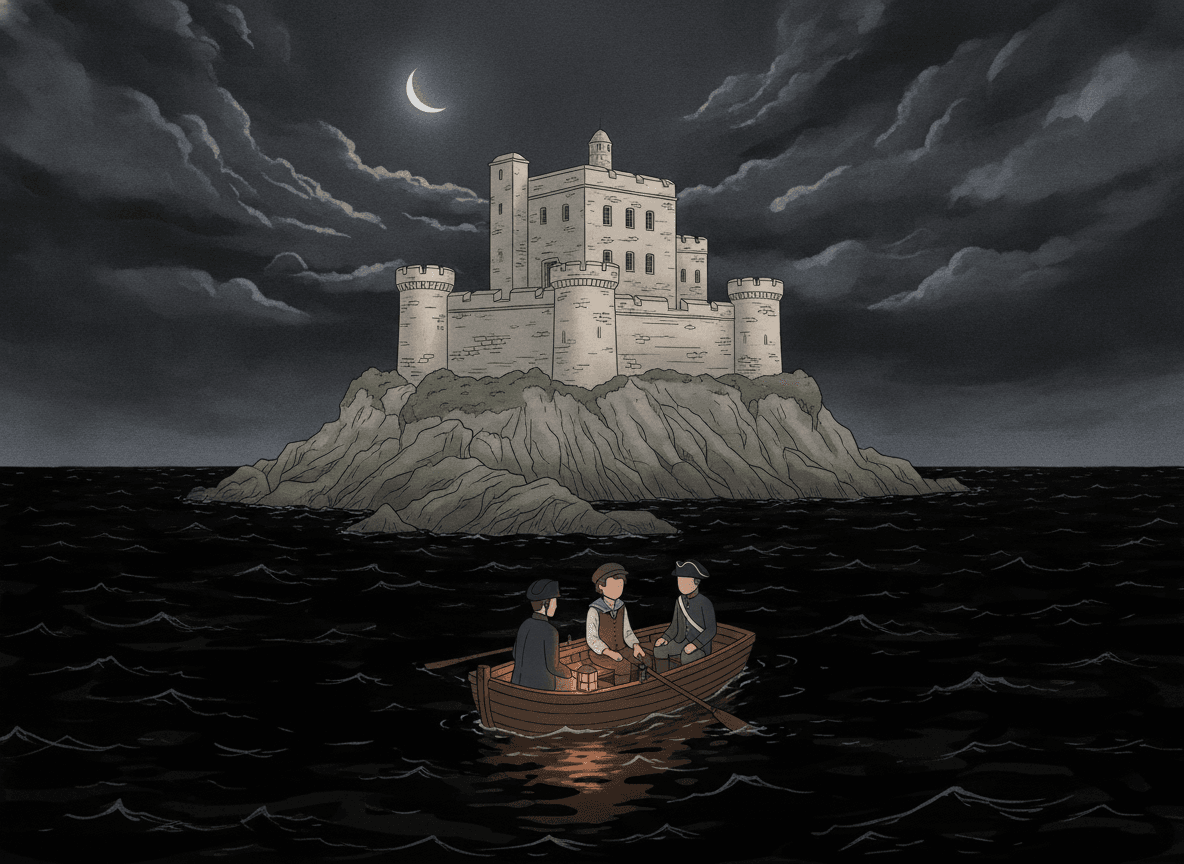
The result is a revenge novel on a huge scale. Edmond Dantès, a young sailor from Marseille, is framed as a Bonapartist agent on the eve of his wedding in 1815, spends fourteen years in the island prison of the Château d'If, and escapes to return as a fabulously rich count who ruins the men who destroyed him.
The Journal des Débats ran it in installments from August 1844 to January 1846, and Paris waited on every episode. The story was set in the recent past, so readers recognized their own world of bankers, newspapers, telegraph lines and the stock exchange. Pirated editions appeared in Belgium at once, and an English translation followed in 1846.
Dumas spent the money as fast as it came. He built a real Château de Monte-Cristo outside Paris, with a tiny writing pavilion on an island in a moat, and opened it with a lavish party in 1847. Within two years his creditors had taken it. His own theatre staged the novel in 1848 across two evenings. Since then the book has fed films in every decade, a 2024 French version that drew enormous crowds, and even a Japanese anime. Its template, the wronged man who returns with a new name and limitless money, shapes revenge stories to this day. The novel's last words are "wait and hope."
Continue in the app
Open the app for the illustrated story of this book and the world it was written in. The book itself is in the public domain: the app opens the free text in its reader, on screen or read aloud with Premium.
- ✓ The illustrated story of the book
- ✓ The world it was written in, on the map and timeline
- ✓ The free public-domain text, opened in the app's reader
Illustrations are created with AI assistance. Summaries are written with AI and reviewed by the editor. Book metadata comes from Wikidata and Open Library.