
Books ›
c. 1100 · Nishapur
Rubáiyát of Omar Khayyám
An astronomer of Nishapur, a jug of wine, and a sky that will not answer
- Author
- Omar Khayyám
- Written
- c. 1100
- Original title
- رباعیات خیام
- Original language
- Persian
- Set in
- Nishapur, Iran
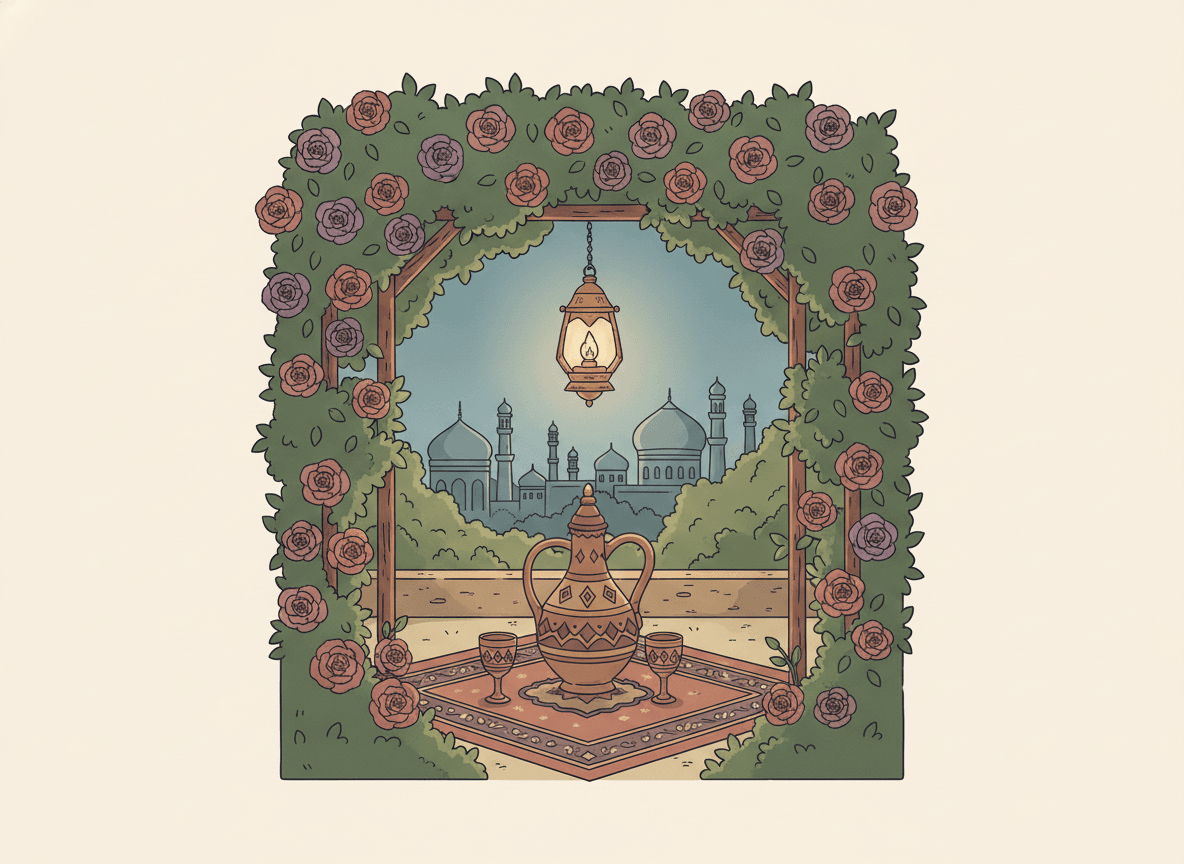
How this book came to be
In the eleventh century, Nishapur was one of the great cities of the Persian world: a hub of trade, libraries and learning in what is now northeastern Iran. Omar Khayyám lived there under Seljuk rule, and in his own lifetime he was famous not as a poet but as a mathematician and astronomer. He wrote a treatise on cubic equations that scholars still admire. He helped reform the Persian calendar under Sultan Malik-Shah, producing a solar year of remarkable accuracy.
The poetry seems to have been a private matter. The rubáiyát are quatrains, four-line poems, each one self-contained. They circle around wine, mortality, the silence of the heavens and the uselessness of arguing about what no one can know. Because they were short and easy to memorize, they traveled by copying and by mouth. That is also why scholars cannot agree on how many are really his. Manuscripts collected over centuries pile up hundreds of quatrains under his name, and many were almost certainly written by other people who found his voice convenient for saying dangerous things. Some skepticism about God and fate was safer attached to a dead astronomer than to a living poet.
The book's second life began in Victorian England. In 1859, Edward FitzGerald, a quiet English gentleman with a taste for Persian, published his own loose version of seventy-five quatrains. He put no name on it. It sold nothing. The unsold copies were dumped into a bookseller's penny box, where a browsing scholar found it and passed it to the poet Dante Gabriel Rossetti and his circle. Word spread from there, and within a few decades FitzGerald's Omar was one of the most quoted poems in English. Admirers founded an Omar Khayyám Club in London in 1892.
FitzGerald reshaped his source heavily, so what English readers love is a collaboration across some seven hundred and fifty years. The result made Khayyám a world author. It also sent readers back to the Persian originals, and to a lasting argument about what a translation owes the poet it carries.
Continue in the app
Open the app for the illustrated story of this book and the world it was written in. The book itself is in the public domain: the app opens the free text in its reader, on screen or read aloud with Premium.
- ✓ The illustrated story of the book
- ✓ The world it was written in, on the map and timeline
- ✓ The free public-domain text, opened in the app's reader
Illustrations are created with AI assistance. Summaries are written with AI and reviewed by the editor. Book metadata comes from Wikidata and Open Library.